Solutions

The same platform, shaped to the work.

Veridata ships as one system, but meets four different kinds of work. Below: what each type of institution asks, and what we deliver.

01 · Diagnostic labs

Make the variant call the start of the workflow, not the end.

Diagnostic labs sit on richer genomic data than any other partner, and it mostly leaves as a PDF. Veridata turns the report into a live object: searchable, re-classifiable, trial-matchable, and signed back by the ordering clinician. The value doesn't end the moment it's exported.

On the revenue side, the claim is defensible before it's submitted, not after it's denied. Denial prevention, not denial management.

ACMG re-classification NCTN trial matching Ordering-MD portal QC dashboards LIMS · HL7 v2 ingest Signed report export Pre-submission evidence NCCN · LCD matching Automated appeals
In practice

Donor selection at GPU speed.

A cell therapy network had GPUs and matching algorithms, but urgent donor matching still took days due to manual scheduling.

Capability: automated match orchestration on GPU-attached compute, with audit-tracked routing that prioritizes urgent cases without losing the lineage trail.

AutomatedMatch flow
Audit-trackedUrgent routing

Integration at growth pace.

A diagnostics company was onboarding health-system customers faster than engineering could build integrations. Weeks of HL7 parsing and patient-matching logic per site.

Capability: new connections become configuration, not code. End-to-end provenance on every inbound and outbound flow, no per-site engineering tax.

Config, not codeNew connections
End-to-endProvenance
02 · Oncology programs

A tumor board that carries its own evidence.

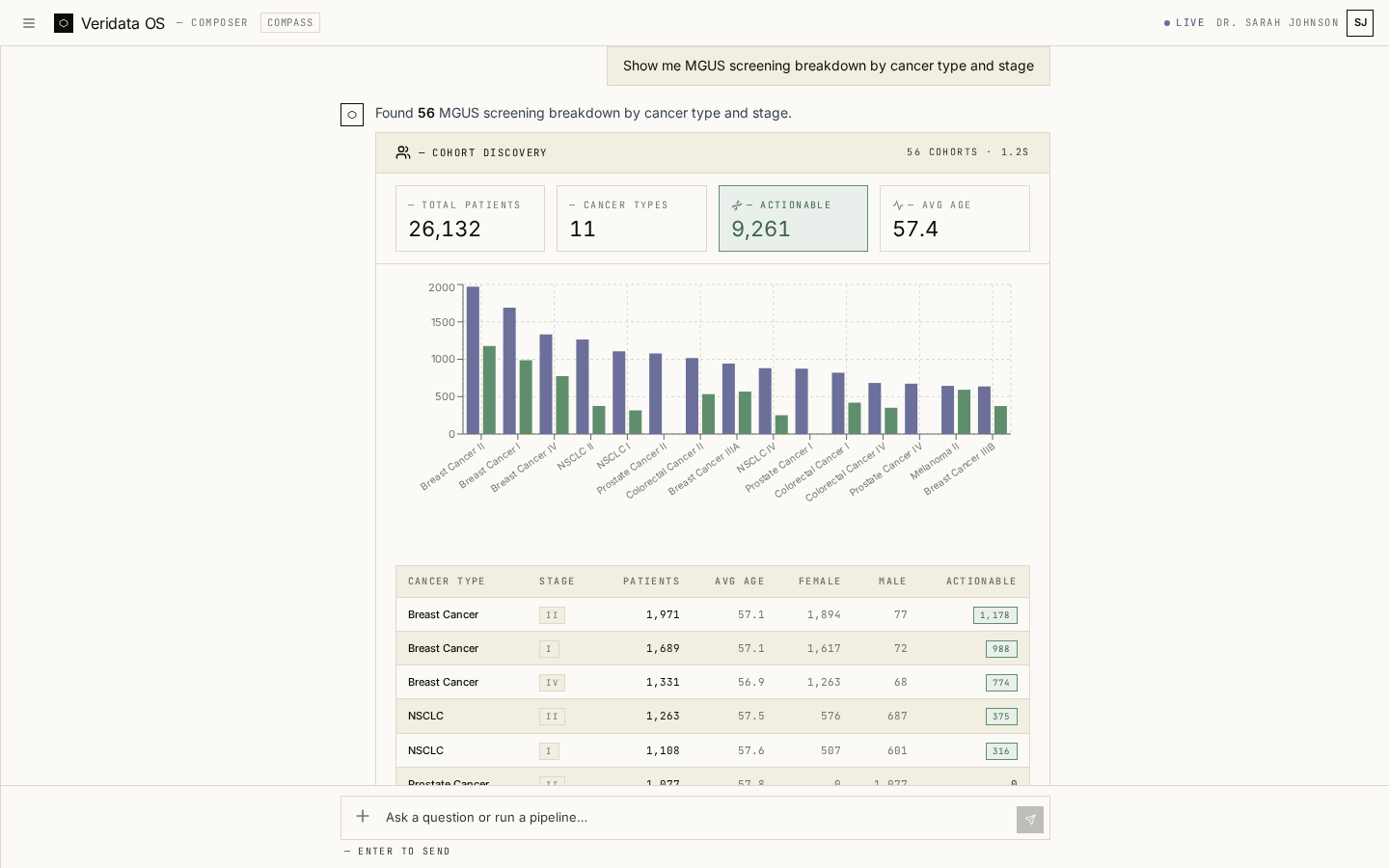
Academic cancer centers, community oncology, IDNs, NCI-designated programs. Every disease group runs its own version of the same loop: surface eligible patients, align evidence, decide, document. Veridata collapses that loop into a signed Insights artifact that can be pulled back up next week, next quarter, or at audit. Matches trace to the variant, not the prompt.

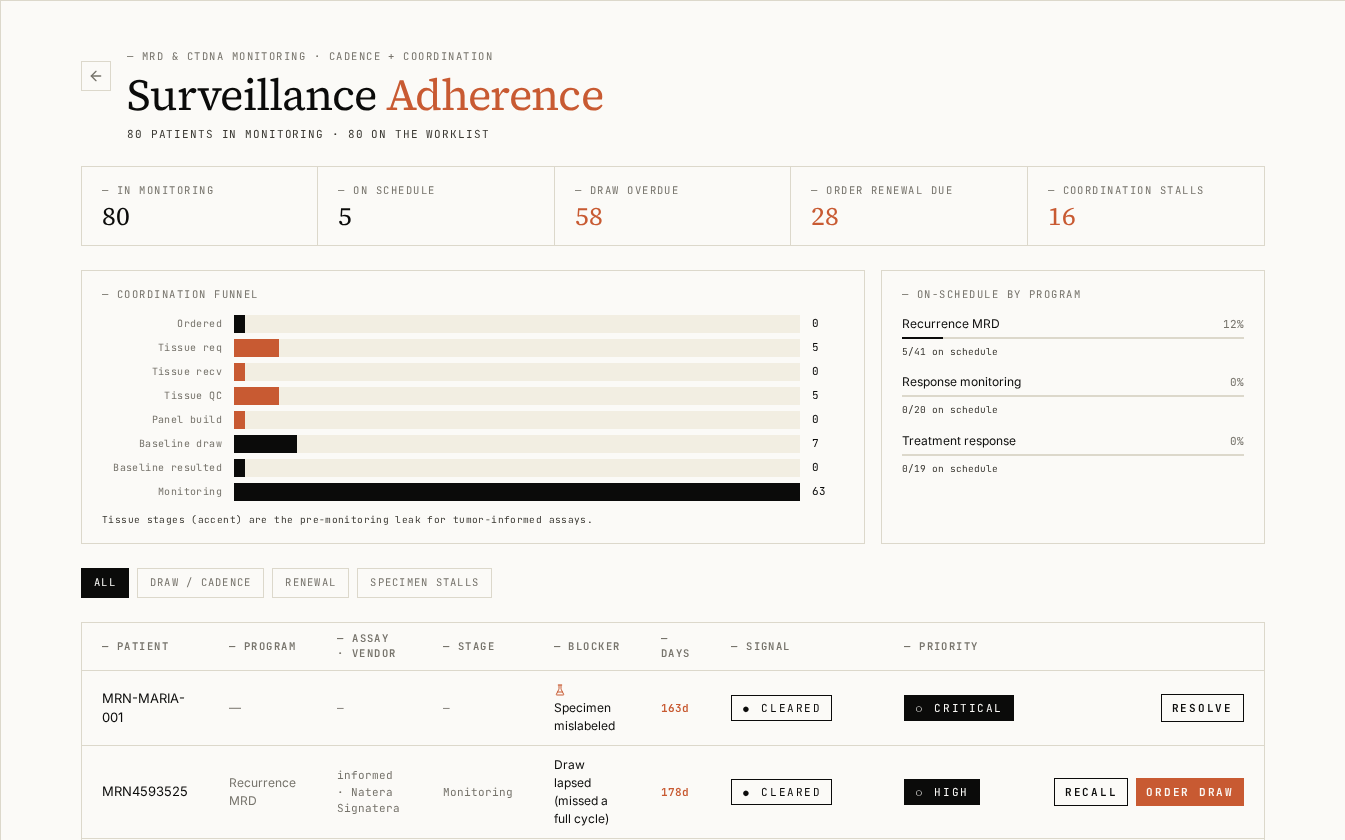
Most platforms stop at the variant. Veridata runs the full arc: population-level analytics to a single patient to the coordination that actually moves them through treatment. Oncology programs carry the biggest coverage gaps in healthcare: scheduling, authorizations, transport, language. Agents handle the routine, escalate only the complex, and every step traces back to the patient record.

ctDNA surveillance Therapy matching MDT packet generation Longitudinal cohorts Epic · Cerner connectors IRB attestation
In practice

Automated trial eligibility.

A precision oncology program was manually screening patients against trial eligibility. Days per patient, with viable matches still missed across hundreds of protocols.

Capability: eligibility screening automated against live ClinicalTrials.gov data: genomic profile, biomarkers, prior therapies, staging.

Live CT.govMatch against
Multi-criteriaAutomated match

Longitudinal molecular surveillance.

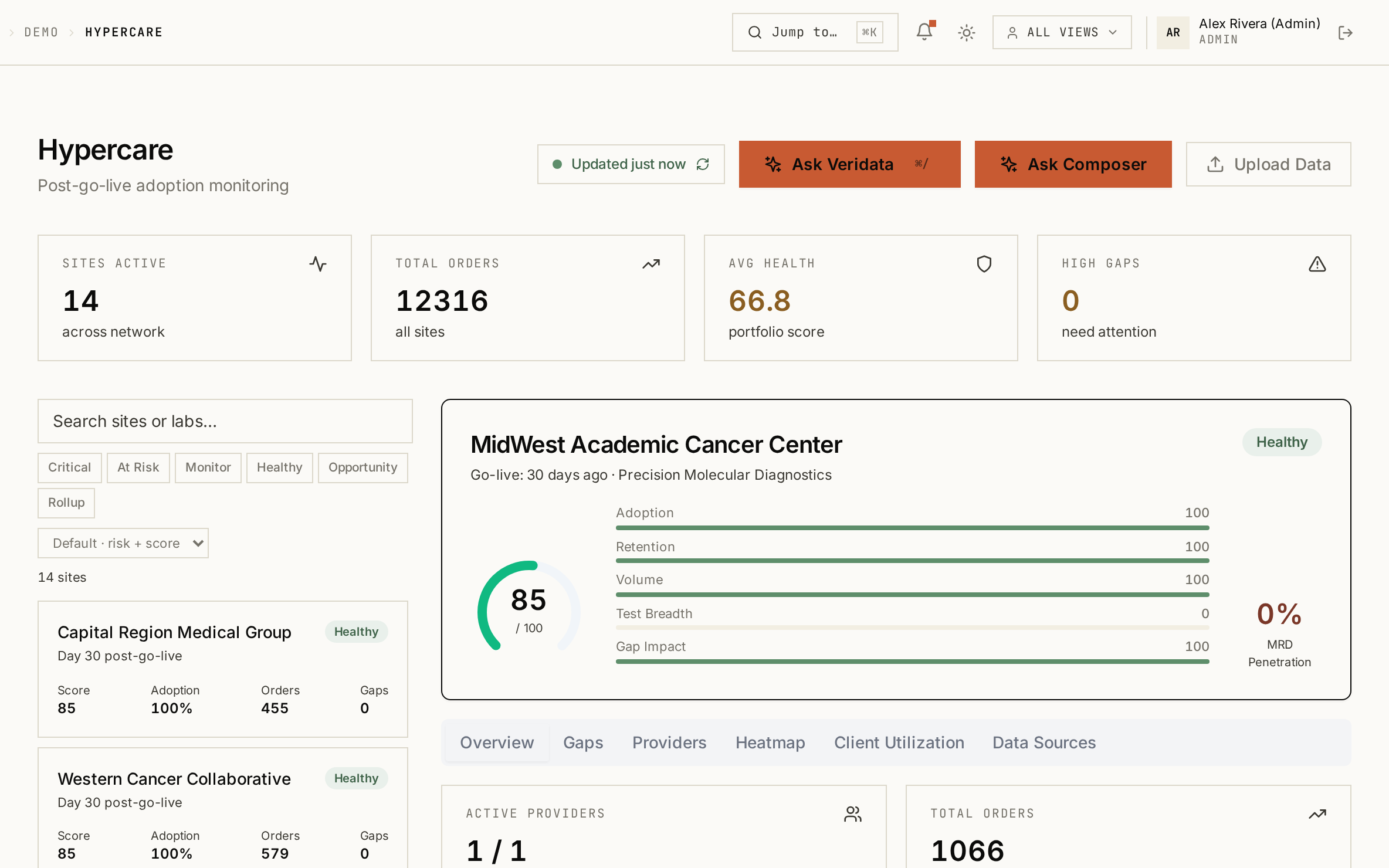
A multi-site network was generating genomic, proteomic, and ctDNA data across platforms and timepoints, but couldn't connect signals longitudinally.

Outcome: multi-omic data unified into a single longitudinal view, linking ctDNA dynamics, variant trajectories, and proteomic shifts.

Multi-omicUnified view
Real-timeSignal detection

When care coordination executes itself.

An oncology practice was losing patients to coordination breakdowns: scheduling, authorizations, transportation, language. Not clinical care.

Capability: navigation execution agents track each patient's journey and escalate only the complex cases. Routine coordination becomes tracked work rather than missed work.

Auto + escalateNavigation flow
Per-patientTracked journey
03 · BioPharma

Feasibility and enrollment, without the central data grab.

Sites don't want another extract. They want the work their clinicians already do to count toward your trial. Veridata runs feasibility on a federated footprint, and converts signal into enrollment with site-owned data paths.

On the regulatory side, every AI output carries its own lineage: input, transformation, model version, signature. When the FDA asks how a decision was made, the answer is immediate, not reconstructed.

Federated feasibility Enrollment acceleration RWE · external control arms Site payments audit Regulatory-grade signing Safety signal scan
In practice

FDA-ready AI provenance.

A biotech had strong AI-driven clinical recommendations but couldn't prove how decisions were made, blocking FDA readiness.

Capability: immutable lineage for every input, transformation, and model version. Audit responses query the lineage graph directly instead of reconstructing it after the fact.

Full traceEvery AI output
On demandAudit response
04 · CROs

A substrate for running ten sponsors on one rail.

The per-sponsor buildout is eating your margin. Veridata gives you one platform to stand up per-site, then attach any sponsor's study on top, with permission boundaries, branding, and audit isolation handled.

Multi-tenant workspaces Sponsor-scoped RBAC Study-level audit logs eTMF handoff EDC · IRT connectors PV workflow
The first 90 days

A measured rollout, not a platform swap.

Veridata arrives next to your current stack, not on top of it. We run a single question end-to-end in the first month, then fan out.

Week 1–2
Connect

Stand up isolated VPC. Mirror two source systems through read-only connectors. Validate row counts against source.

Week 3–6
First question

Run one real clinical question end-to-end. Compare row-by-row against your existing process. Sign the result.

Week 7–10
Fan out

Onboard additional users across clinical, research, operations. Layer in the next source systems. Build a second Insights artifact.

Week 11–12
Hand off

Institutional admins take over tenancy management. Veridata becomes a tool your team reaches for by default, with us in the loop for new surfaces.

Start

Bring a question. We'll bring the platform.